The eMudhra Certificate Incident: Why Eight Weak Keys Became a Big Internet Security Issue
Eight weak certificate keys, the risk they created, and how browsers responded

A simple look at what happened, why it mattered, what browsers did, and what we still do not know.
Last checked: 21 October 2026. This is a developing incident; the cause and impact may be updated.
Table of Contents
The security story: why this matters
Meet the players: who trusts whom?
What happened: the timeline
The security issue: what a weak key could allow
The response: how browsers contained the risk
What this incident teaches us
1. The Security Story: Why This Matters
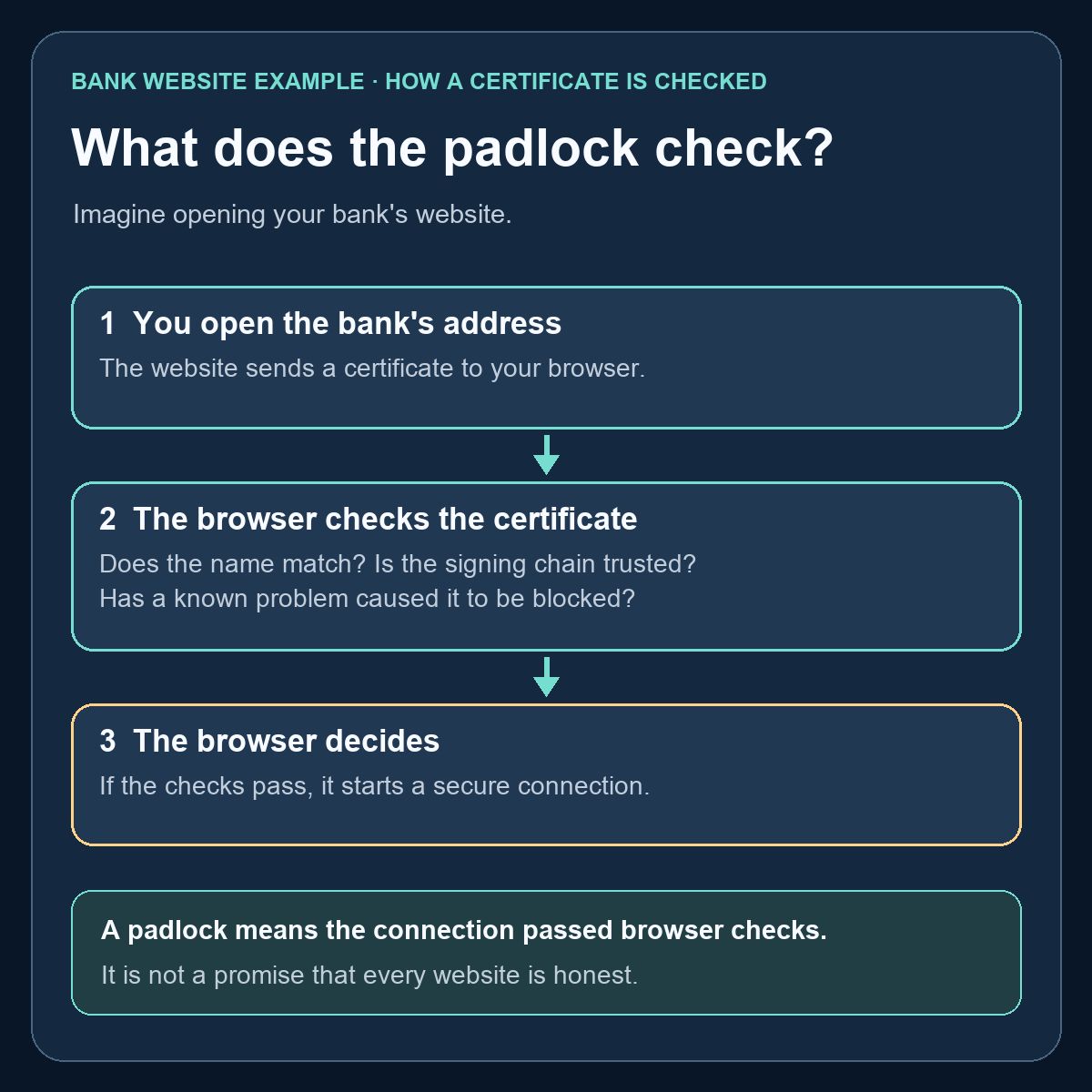
Imagine opening your bank's website. You see the padlock in your browser, so you assume that you are speaking to the real bank and that the connection is private.
That padlock depends partly on a digital certificate. A certificate is a statement from a trusted organisation: this website is allowed to use this name. The browser checks that statement before it trusts the connection.
In October 2026, a researcher found that eight certificates belonging to eMudhra's intermediate certificate authorities had extremely weak private keys. These were not ordinary website certificates. They were one level higher: they could sign certificates for websites. Six were for website security; two were for code signing. Mozilla independently recovered the keys, showing that the problem was real and easy to reproduce. Mozilla's incident record
The word compromised can sound like someone broke into a server and stole files. That is not what the public evidence shows here. The known problem is that the keys were created so weakly that someone could work them out from the public information in the certificates. eMudhra says its infrastructure was not compromised and no data was breached. Its investigation into the precise cause is still ongoing. eMudhra's incident statement
So why is this a big issue if no data breach has been reported? Because an intermediate CA key is a powerful permission to vouch for other certificates. If an attacker could use one before browsers blocked it, they could create a convincing certificate for a website they did not own. An attacker would still need a way to intercept or redirect a user's connection. The weak key alone would not put them on the network or give them a bank password. But it could remove an important warning that normally stops an impersonation attempt. Mozilla Security Blog
That gap between potential danger and observed harm is the central story of this incident.
2. Meet the Players: Who Trusts Whom?
The browser: the checker
Your browser checks a website's certificate when it opens an HTTPS connection. It asks: Is the certificate for this website's name? Is it still valid? Does it lead back to an authority I trust? Has a known problem caused it to be blocked?
The root certificate authority: the starting point of trust
A root certificate authority, or root CA, is at the top of this trust chain. Browsers and operating systems keep lists of roots they trust. A root does not normally sign every website certificate itself. It delegates that job to intermediate CAs.
The intermediate CA: the delegated signer
An intermediate CA sits between the root and the website. Think of the root as a company director who authorises a manager to approve identity documents. If the manager's signing stamp can be copied, forged approvals can look genuine until the stamp is blocked.
That is the level involved in this eMudhra incident. The root's private key was not reported as compromised. The eight weak keys belonged to intermediates. A root can still be removed from a browser's trust list as a protective response to weak intermediates beneath it. Those are different facts. eMudhra's statement · Mozilla's response
The website: the final link
A website presents its own certificate to your browser. The browser follows the signatures from the website certificate, through an intermediate, to a trusted root. If that chain passes the browser's checks, the browser can start a secure connection.
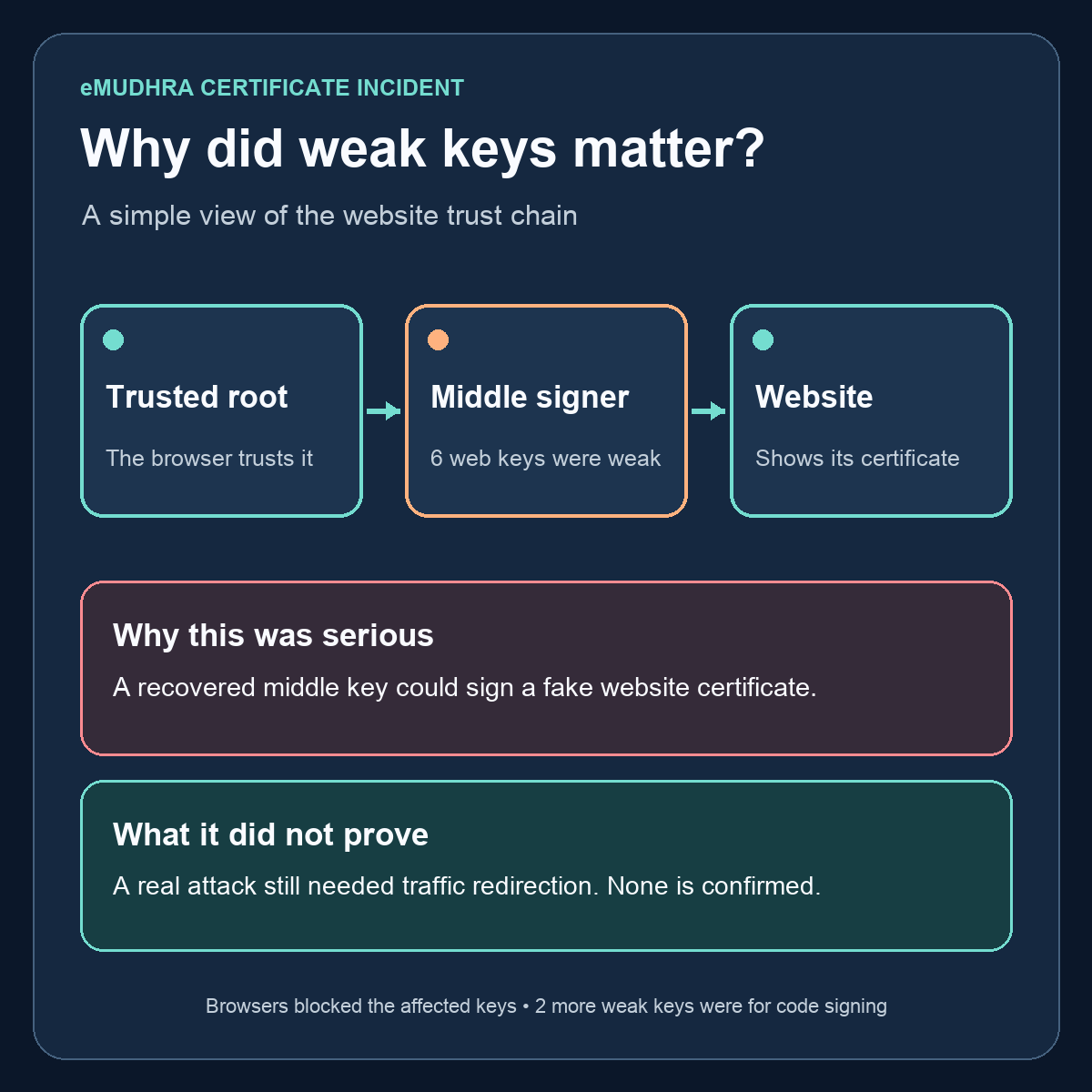
Why the middle link matters: A stolen or guessable website key affects one website. A guessable intermediate CA key can potentially be used to sign certificates for many website names. That makes it a much wider trust problem.
3. What Happened: The Timeline
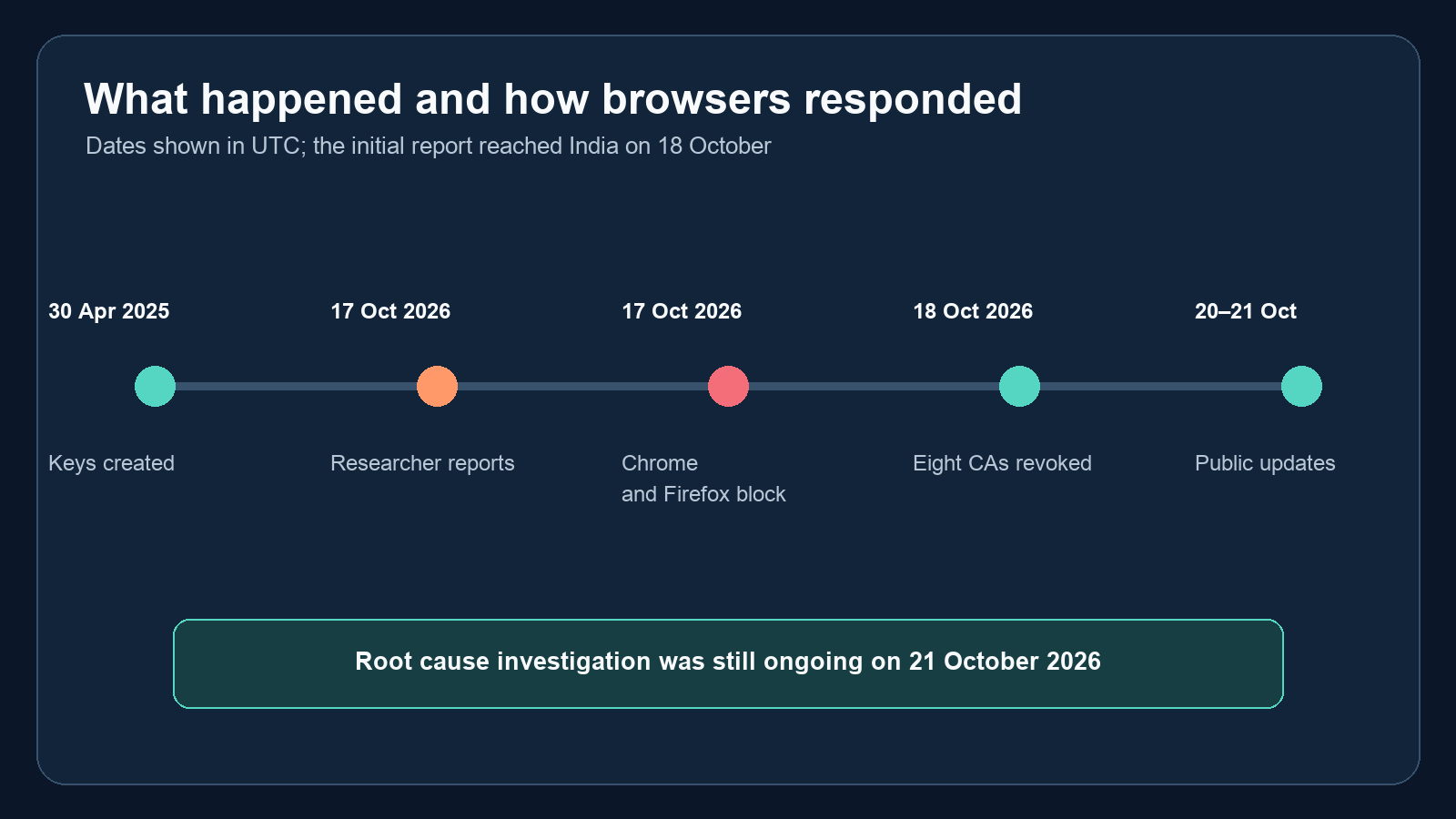
The affected keys were created during an eMudhra key generation event on 30 April 2025. The issue was reported to browser vendors and eMudhra on 17 October 2026 UTC. That was the early morning of 18 October in India. Mozilla says it received the report at 20:06 UTC and independently recovered the keys at 21:48 UTC. Mozilla incident record
Chrome says it confirmed the report and pushed a block for the six affected website issuing keys on 17 October. Mozilla completed its Firefox block later that day. eMudhra marked all eight intermediates as revoked on 18 October UTC. Mozilla and eMudhra published public explanations on 20 October; eMudhra added an update on 21 October. Chrome Root Program update · Mozilla incident record · eMudhra's statement
Here are the facts that matter most:
| Question | What the public record says |
|---|---|
| How many weak intermediate keys? | Eight. Six were for HTTPS website certificates and two were for code signing. |
| Was eMudhra's root private key exposed? | No such compromise has been reported. The affected keys were intermediate keys. |
| Were website certificates issued from these eight intermediates? | eMudhra says no. Chrome says no certificates from the six HTTPS intermediates appeared in Certificate Transparency logs before its block. |
| Was customer data stolen? | eMudhra says its infrastructure was not compromised and no data was breached. Public reports do not establish a data theft event. |
| Is the exact cause known? | eMudhra has described a likely weak key creation step involving key wrapping, but says its full root cause investigation is unfinished. |
The detail that makes this case unusual is the weakness itself. Mozilla found that the affected P-384 private keys had values below 256. In plain English: keys meant to be chosen from an enormous range were effectively chosen from a tiny set. Checking that tiny set was enough to recover them. This did not mean the P-384 method itself was broken. It meant these particular keys were created incorrectly. Mozilla's technical analysis in the incident record
eMudhra says the keys were made using certified security hardware, but a step in its key creation process produced a second, weak set that was published. It has not yet confirmed the full cause. Certified equipment helps, but a mistake in the process around it can still produce a bad result. eMudhra's 21 October update
4. The Security Issue: What Could a Weak Key Allow?
A possible attack, step by step
Suppose an attacker knew how to recover one of the weak intermediate keys. They could use it to sign a fake certificate claiming to belong to a popular website. That forged certificate might look as if it came from a trusted chain.
But signing a certificate is only one part of an attack. The attacker would also need to get the victim to connect to them. That could involve control over a network, a device, or another way to redirect traffic. If the attacker could do that and the victim's browser accepted the forged certificate, the attacker might impersonate the site and read or change information passing through the connection. Mozilla Security Blog
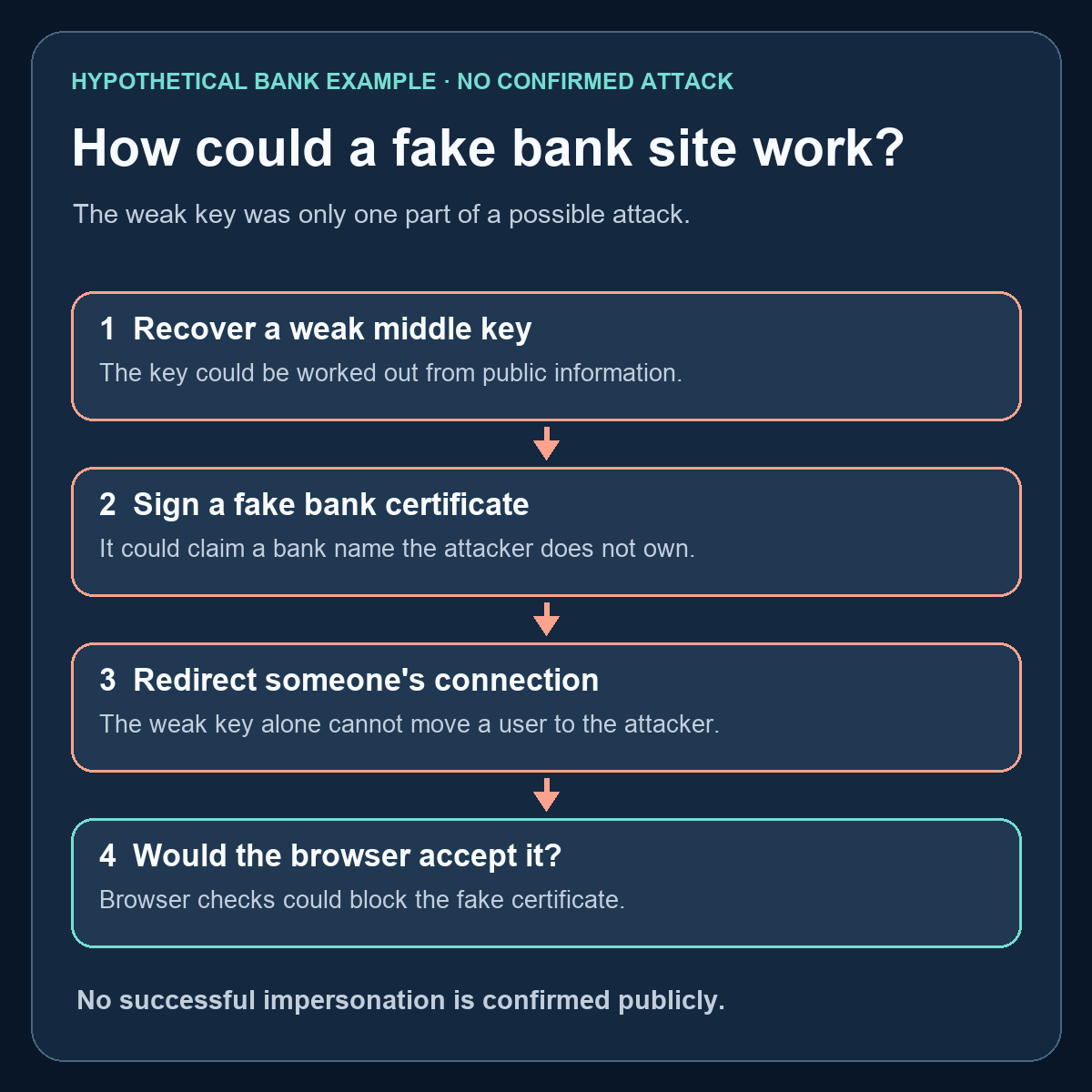
This diagram shows a possible path, not a confirmed attack. As of 21 October, the public sources cited here do not show that this path was used against anyone.
Why “no certificates issued” does not make the weak keys harmless
eMudhra says none of the eight affected intermediates issued a customer website certificate. That is reassuring for existing customers of those intermediates: there were no legitimate website certificates from them that needed a direct replacement. eMudhra's statement
However, the central risk was that someone outside eMudhra could create a certificate using a recoverable private key. A company's own issuance records cannot, by themselves, rule out that possibility. This is why browser teams acted on the weak keys immediately, even without evidence of a successful attack. Mozilla incident record
Why a padlock alone is not the full story
The padlock tells you that the browser accepted an HTTPS connection. It does not mean the site is honest, and it depends on the browser making a sound trust decision. Normally, the certificate chain helps the browser detect an impostor. A weak intermediate key threatens that decision because forged certificates can carry signatures that appear valid.
Modern browsers add more checks. One is Certificate Transparency: public logs that make issued website certificates visible to monitors. Chrome says that before its block, no website certificates from the six affected HTTPS intermediates were in those logs. Because Chrome normally requires such logging for certificates under its trusted roots, Chrome says a forged certificate from those intermediates could not have been trusted by default in Chrome before the block. That is a strong safeguard for Chrome users, but it should not be treated as proof that every browser, app, or device had the same protection. Chrome Root Program update
What about the two code signing intermediates?
Code signing certificates are used to show who signed software. Two of the eight weak intermediates were for that purpose, so this was not only a website certificate issue. Chrome said these two could not be used as website certificate chains under Chrome's rules. eMudhra says neither issued certificates. The public record does not establish that malicious software was signed with them. Mozilla incident record · Chrome Root Program update · eMudhra's statement
5. The Response: How Browsers Contained the Risk
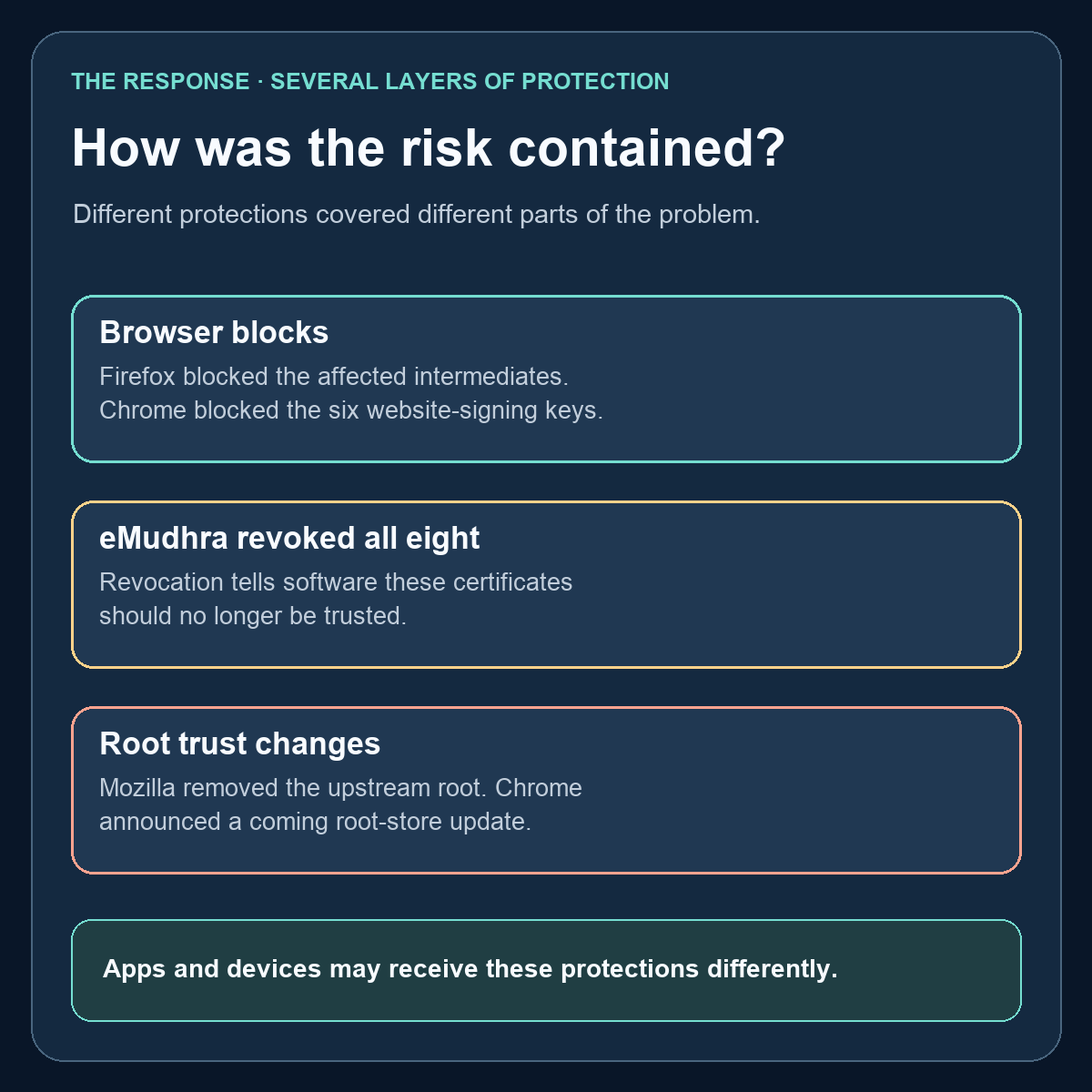
First response: block the affected intermediates
Mozilla put the affected certificates on Firefox's central block list, called OneCRL. It says standard Firefox installations received this protection without users having to restart or install a browser update. Mozilla also released Firefox updates for people whose custom settings might have stopped the block list from arriving. Mozilla Security Blog
Chrome pushed a CRLSet block for the six HTTPS intermediate keys. It blocked the keys themselves, which also covered certificates using the same keys under a different signing chain. That matters because some of the affected intermediates had been cross-signed by another authority, Sectigo. Chrome says this block reached users without a browser restart or update. Chrome Root Program update
eMudhra revoked all eight affected intermediates. Revocation is the CA's way of saying: do not trust these certificates anymore. But not every app checks revocation in the same way or at the same time. That is why browser specific blocks were valuable. Mozilla's community guidance · Mozilla incident record
Second response: remove a root from trust lists
Mozilla also removed the root above the affected intermediates from its NSS trust list. Chrome announced a coming root store update for the same upstream root. This is a broader safety step for software that uses those root lists but does not receive the browser's specific block. It does not mean the root private key was found to be weak. Mozilla's community guidance · Chrome Root Program update
A broader root removal has a cost: sites using otherwise valid certificates under that root may have to move to new certificate chains. eMudhra says this affects one customer ecosystem in the United States and that it is helping replace those certificates. eMudhra also says its Indian digital signature and eSign services are unaffected; that is its reported assessment, not a claim that every eMudhra product uses the same certificate system. eMudhra's statement
What should readers do?
For most people, the practical action is simple: keep your browser and operating system updated, and do not bypass certificate warnings. Browser teams have already pushed the main protections described above. There is no evidence here that ordinary users need to change passwords or remove certificates manually because of this incident.
If you operate a website or an app that depends on eMudhra certificates, check which root and intermediate your certificate uses. Follow your certificate provider's direct guidance on replacement and test the new chain across the browsers and devices your users rely on. eMudhra's customer update
6. What This Incident Teaches Us
The important failure was not that online certificates are useless. The important failure was that a certificate issuer created keys with almost no secrecy, and those keys sat in a place where they could vouch for other certificates.
Three lessons stand out:
Power matters as much as exposure. A weak key for a delegated certificate authority is more serious than a weak key for one website, because it can approve many names.
Security hardware is only part of the process. eMudhra says certified hardware was used. The published keys were still weak. Key creation needs checks that catch bad outputs before they become trusted.
Fast, layered responses matter. Certificate Transparency, browser block lists, revocation, and root store changes each covered a different part of the risk. None should be assumed to protect every app and device in exactly the same way.
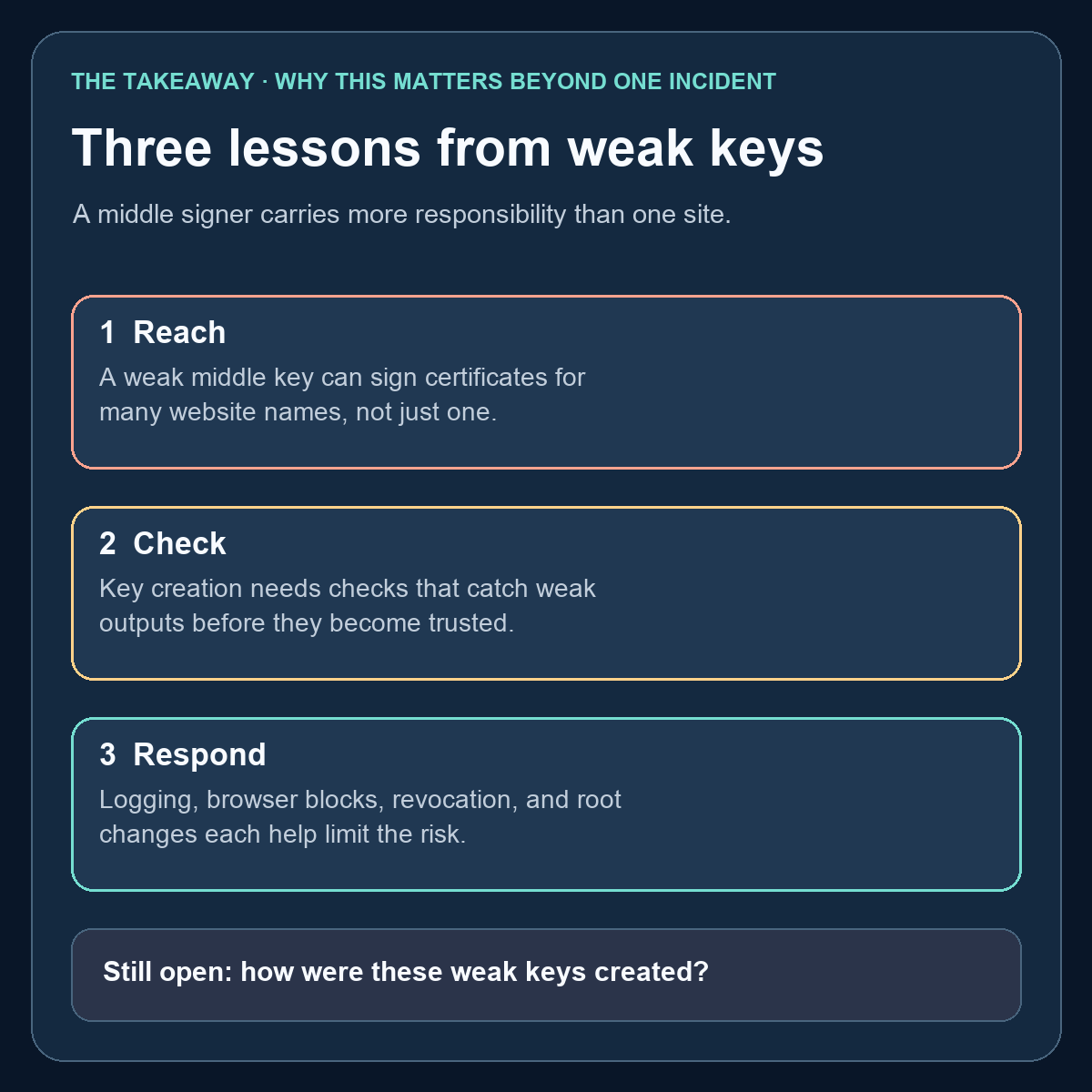
There is still an open question: how did the key creation process produce and publish the weak keys? eMudhra has offered an initial explanation involving a key wrap and unwrap step, while saying its full investigation is not complete. The details of that investigation, and any later evidence about misuse, may change the assessment. eMudhra's statement
For now, the careful conclusion is this: eight intermediate CA keys were recoverable, the potential trust failure was serious, and browser teams moved quickly to block the risk. The public evidence cited here does not establish a network intrusion, stolen customer data, or a successful impersonation attack.
Sources and further reading
Mozilla Bugzilla: Detailed incident record and technical discussion
Mozilla security policy discussion, including Chrome Root Program response
eMudhra: Certificate security incident statement and updates
Illustrations and diagrams are explanatory. The attack path is hypothetical.
Comments
Join the discussionThe no-certificates-issued point is the one people miss. A weak intermediate undermines the whole chain of trust below it, which is why blocking the intermediates first and then pulling the root from trust lists was the right escalation.
